New Research Consortium Report Explains Why Insurers Must Take the Lead in Changing the Way We Approach Cancer Treatment
Most cancer patients get suboptimal care due to old one-size-fits-all treatment models. Payers must lead the transition
Press Release Disclaimer: This is a press release distributed through the XPR Media network. It has not been independently verified by our newsroom.
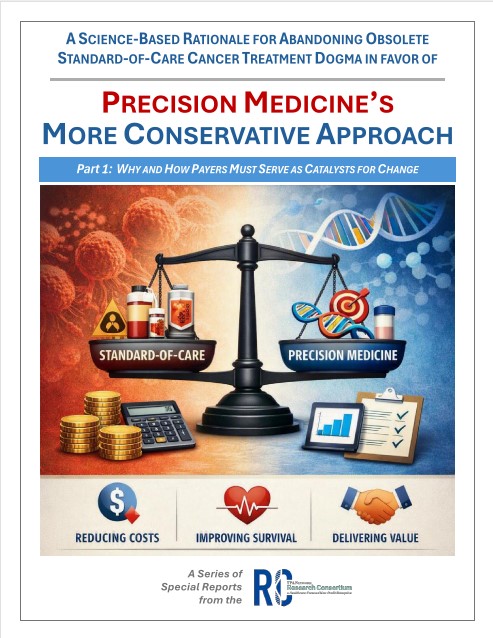

Most cancer patients get suboptimal care due to old one-size-fits-all treatment models. Payers must lead the transition to genomic-based precision medicine.
SAN DIEGO, CA, UNITED STATES, September 30, 2026 /EINPresswire.com/ — A new report from the nonprofit TPA Network Research Consortium explains why payers must bear much of the responsibility for changing how we approach cancer treatment. The first-in-a-series report details how insurers and employers can help drive this change by following the organization’s “Precision Medicine Protocol”, a framework for supporting an individualized approach to cancer care.
As many as 80% of cancer patients receive suboptimal care, in large part because of the continued reliance on organ-based, one-size-fits-all clinical guidelines that do not account for the variation among individual cancers …. so says Research Consortium founder Richard Nicholas. When treatment decisions are guided by these generalized approaches rather than by the unique characteristics of each patient’s cancer, patients may receive toxic, high-cost regimens that offer limited or no clinical value. Instead, treatment should be more appropriately aligned with the patient’s biology.
Precision Medicine integrates modern genomics into cancer care, substantially deepening our understanding of the disease and transforming how it can be treated. Rather than relying on sameness-based, standard-of-care approaches, it uses each patient’s unique molecular profile to guide the selection of therapies that are biologically matched to their cancer. This approach helps identify targeted, potentially more effective drugs while eliminating treatments that are unlikely to provide clinical value. By avoiding ineffective therapies, precision medicine can reduce unnecessary toxicity and improve outcomes while containing cost; it stands in stark contrast to obsolete, sameness-based treatment guidelines.
Nicholas, a 48-year healthcare industry veteran, believes that payers continue to perpetuate suboptimal cancer care because they have not made a meaningful commitment to precision medicine. He boldly asserts:
“Organ-based cancer treatment must be superseded, as it excuses decision-making based on incomplete knowledge. By contrast, precision medicine’s science-based, look-before-you-leap treatment approach is a far more conservative course of action versus blindly following outmoded pre-genomic era dogma. It is high time that payers and employer plan sponsors earnestly embrace precision medicine. To do otherwise would be to continue to deny patients access to vital genomic testing and the opportunity to try potentially viable FDA-approved cancer drugs; permitting continued wasteful spending on expensive low-clinical-value drugs.”
Payers’ Responsibility to Advance Precision Medicine
Comprehensive health care coverage is a cornerstone of effective cancer care; and coverage decisions shape access, quality, cost, and outcomes throughout the cancer journey. This influences everything from the initiation of treatment through long-term survivorship. When coverage decisions deny, delay, or disrupt access to care, they affect the treatment patients receive and the outcomes they experience. Nicholas argues that because payers make coverage decisions, much of the responsibility for driving the transition to precision medicine rests with them. He reasons that responsibility cannot rest entirely with providers and health systems, which do not control coverage determinations. Payers must therefore embrace precision medicine and support coverage decisions that advance more effective cancer care, rather than continuing to accept ineffective treatments and wasteful spending on them.
A Practical Framework for Advancing Precision Medicine
To help health insurers and employers drive meaningful change, the Research Consortium created a “Precision Medicine Protocol” as a practical framework for supporting more effective, individualized cancer care. This first-in-a-series report describes the protocol and explains how and why payers can support its use. It also examines how payers can promote cancer care that is better aligned with individual patient needs while addressing the quality, cost, and value considerations that shape coverage decisions. Later installments will provide additional detail about the protocol, challenge conventional thinking about the cost and value of combination drug treatments and show payers how to gain greater control over oncology drug spending. Download the report here.
Support or Collaborate with the Research Consortium
It takes 15 years on average for a new medical innovation to gain widespread clinical acceptance. In cancer care however, there is broad agreement that we don’t have that long to transition to precision medicine. This initiative builds on our previous work “Equipping Patients, Physicians and Payers to Outsmart Cancer with Game-Changing Technology for Precision Medicine” (See this webpage).
To learn how you or your organization can help expedite the adoption of precision medicine by collaborating with us … or financially supporting the “Advancing Personalized Cancer Care” initiative … click here. Cancer patients will be glad that you did.
Richard Nicholas
TPA Network Research Consortium
+1 858-395-4114
Richard@ResearchConsortium.org
Visit us on social media:
LinkedIn
Legal Disclaimer:
EIN Presswire provides this news content “as is” without warranty of any kind. We do not accept any responsibility or liability
for the accuracy, content, images, videos, licenses, completeness, legality, or reliability of the information contained in this
article. If you have any complaints or copyright issues related to this article, kindly contact the author above.

Media gallery